ProofPack: Tokenizing Real-World Assets with Selective Disclosure
06 Jan 2026
06 Jan 2026 by Luke Puplett - Founder

ProofPack: Tokenizing Real-World Assets with Selective Disclosure
This document explains how ProofPack enables the tokenization of real-world assets—like insurance quotes and invoices—through selective disclosure. It demonstrates how you can create verifiable, tradeable proofs that reveal only what's needed at each stage of a transaction, while maintaining cryptographic proof of authenticity.
Why Tokenization Needs Selective Disclosure
Traditional asset tokenization faces a fundamental privacy challenge: you need to prove an asset exists and has value, but you don't want to reveal sensitive details until the right moment.
Consider these scenarios:
-
Insurance Quote Marketplace: Multiple insurers need to bid, but shouldn't see personal medical history until they win
-
Invoice Verification: Customs needs to verify duties were paid correctly, but shouldn't see competitive business details
-
Supply Chain Trading: Traders need proof of provenance, but shouldn't see supplier relationships until deal closes
ProofPack solves this by enabling selective disclosure: you can create cryptographically verifiable proofs that reveal only specific information while keeping everything else private. The same proof can be progressively revealed as trust and commitment increase through the transaction lifecycle.
Example 1: Insurance Quote Tokenization on a Marketplace
Note: This is a silly, simplified example designed to illustrate the concept. Real insurance quotes would have many more fields and more complex structures.
The Business Problem
A user has received an insurance quote from Company A. They want to list it on a marketplace where multiple insurance companies can compete to beat the quote. However:
-
Bidders need enough information to make competitive offers (coverage type, quote amount, expiration)
-
Bidders should NOT see personal information (name, address, medical history) until they win
-
Winning bidder needs full personal information to issue the policy
-
All parties need cryptographic proof the quote is authentic and hasn't been tampered with
The Complete Flow
Step 1: Start with the Domain JSON
First, let's see what a real insurance quote document might look like. Here's a silly, simplified example:
{
  "coverageType": "Health Insurance",
  "quoteAmount": "12500",
  "expirationDate": "2025-12-31",
  "fullName": "John Smith",
  "dateOfBirth": "1985-06-15",
  "address": {
    "street": "123 Main Street",
    "city": "London",
    "postcode": "SW1A 1AA",
    "country": "United Kingdom"
  },
  "medicalHistory": "Previous heart condition, no current medications"
}
This is the domain JSON—the actual data structure that represents an insurance quote. Notice that all properties are at the root level. This is important because only root-level properties can become individual leaves for selective disclosure.
Understanding Granularity: Notice in our example that address is a complex object with sub-keys (street, city, postcode, country). This entire object becomes one leaf—you can only hide/reveal the whole address block together.
If you wanted to reveal just the country while hiding the street address, you'd need to promote country to the root level:
{
  "coverageType": "Health Insurance",
  "quoteAmount": "12500",
  "expirationDate": "2025-12-31",
  "fullName": "John Smith",
  "dateOfBirth": "1985-06-15",
  "address": {
    "street": "123 Main Street",
    "city": "London",
    "postcode": "SW1A 1AA"
  },
  "country": "United Kingdom",
  "medicalHistory": "Previous heart condition, no current medications"
}
Now country is its own leaf and can be revealed independently, while the address object (with street, city, postcode) can be hidden as a group.
Design Principle: The structure you choose determines the granularity of disclosure. Complex objects at root level are fine—they just become single leaves that are hidden/revealed together. The ProofPack library automatically handles hex-encoding complex objects—you don't need to manually convert them. If you need finer control, promote specific fields to root level. Flattening can still be "lumpy"—you don't have to break everything down to simple values.
Step 2: Transform Each Property into a Leaf
Now, let's see how each root-level property gets transformed into a Merkle tree leaf. The ProofPack library does this automatically—you just pass in your domain JSON object, and it handles all the encoding. But let's walk through what happens under the hood:
For each root-level property, the library:
-
Takes the property (e.g.,
"coverageType": "Health Insurance"or"address": {...}) -
Wraps it in a JSON object (e.g.,
{"coverageType": "Health Insurance"}or{"address": {...}}) -
JSON stringifies it (e.g.,
'{"coverageType":"Health Insurance"}') -
Converts to hex-encoded string (e.g.,
"0x7b22636f76657261676554797065223a224865616c746820496e737572616e6365227d") -
Generates a random salt (e.g.,
"0x568bdec8fb4a8c689c6c8f93fb16854c") -
Hashes the data + salt using SHA256 (e.g.,
"0xa1e9c94eb6e2528c2672c72f35cc811dd79a1055d1c152fc98cb9388f8f00249")
Let's trace two properties through this process:
Simple property:
-
Original:
"coverageType": "Health Insurance" -
Wrapped:
{"coverageType": "Health Insurance"} -
JSON stringified:
'{"coverageType":"Health Insurance"}' -
Hex-encoded:
"0x7b22636f76657261676554797065223a224865616c746820496e737572616e6365227d" -
With salt:
salt = "0x568bdec8fb4a8c689c6c8f93fb16854c" -
Hashed:
hash = SHA256(data + salt) = "0xa1e9c94eb6e2528c2672c72f35cc811dd79a1055d1c152fc98cb9388f8f00249"
Complex object property:
-
Original:
"address": {"street": "123 Main Street", "city": "London", "postcode": "SW1A 1AA", "country": "United Kingdom"} -
Wrapped:
{"address": {"street": "123 Main Street", "city": "London", "postcode": "SW1A 1AA", "country": "United Kingdom"}} -
JSON stringified:
'{"address":{"street":"123 Main Street","city":"London","postcode":"SW1A 1AA","country":"United Kingdom"}}' -
Hex-encoded:
"0x7b2261646472657373223a7b22737472656574223a22313233204d61696e20537472656574222c2263697479223a224c6f6e646f6e222c22706f7374636f6465223a225357314120314141222c22636f756e747279223a22556e69746564204b696e67646f6d227d7d" -
With salt:
salt = "0x9b2c3d4e5f6a7b8c9d0e1f2a3b4c5d6e7f8a9b0c1d2e3f4a5b6c7d8e9f0a1b2c" -
Hashed:
hash = SHA256(data + salt) = "0x3c8d9e0f1a2b3c4d5e6f7a8b9c0d1e2f3a4b5c6d7e8f9a0b1c2d3e4f5a6b7c8d9e"
Key Point: Notice that the complex address object becomes one leaf—the entire object is hex-encoded as a single unit. The library automatically handles this conversion, whether the property is a simple string, number, or complex nested object.
Important: You don't need to manually hex-encode anything! The ProofPack library (both .NET and JavaScript) automatically:
-
Takes your domain JSON object
-
For each root-level property, wraps it in a JSON object
-
JSON stringifies it
-
Converts to hex
-
Generates salt
-
Computes hash
You simply call merkleTree.AddJsonLeaves(yourDomainJson) and the library handles all the encoding. The manual steps above are just to help you understand what happens under the hood.
Each property becomes one leaf in the Merkle tree.
Step 3: Build the Complete Merkle Tree
When we do this for all 7 properties, plus add a required metadata leaf, we get 8 leaves total. Here's how they map:
-
Leaf 1 (metadata): Required by ProofPack - contains algorithm, leaf count, and document type
-
Leaf 2:
{"coverageType": "Health Insurance"}✅ PUBLIC -
Leaf 3:
{"quoteAmount": "12500"}✅ PUBLIC -
Leaf 4:
{"expirationDate": "2025-12-31"}✅ PUBLIC -
Leaf 5:
{"fullName": "John Smith"}🔒 PRIVATE -
Leaf 6:
{"dateOfBirth": "1985-06-15"}🔒 PRIVATE -
Leaf 7:
{"address": {"street": "123 Main Street", "city": "London", "postcode": "SW1A 1AA", "country": "United Kingdom"}}🔒 PRIVATE (entire address object as one leaf) -
Leaf 8:
{"medicalHistory": "Previous heart condition, no current medications"}🔒 PRIVATE
The ProofPack library assembles these into a Merkle Exchange Document:
Complete Merkle Tree (All 8 Leaves Revealed):
{
  "header": {
    "typ": "application/merkle-exchange-3.0+json"
  },
  "leaves": [
    {
      "data": "0x7b22616c67223a22534841323536222c226c6561766573223a382c2265786368616e6765223a22696e737572616e63652d71756f7465227d",
      "salt": "0x3d29e942cc77a7e77dad43bfbcbd5be3",
      "hash": "0xe77007d7627eb3eb334a556343a8ef0b5c9582061195441b2d9e18b32501897f",
      "contentType": "application/merkle-exchange-header-3.0+json; charset=utf-8; encoding=hex"
    },
    {
      "data": "0x7b22636f76657261676554797065223a224865616c746820496e737572616e6365227d",
      "salt": "0x568bdec8fb4a8c689c6c8f93fb16854c",
      "hash": "0xa1e9c94eb6e2528c2672c72f35cc811dd79a1055d1c152fc98cb9388f8f00249",
      "contentType": "application/json; charset=utf-8; encoding=hex"
    },
    {
      "data": "0x7b2271756f7465416d6f756e74223a223132353030227d",
      "salt": "0x24c29488605b00e641326f6100284241",
      "hash": "0x1b3bccc577633c54c0aead00bae2d7ddb8a25fd93e4ac2e2e0b36b9d154f30b9",
      "contentType": "application/json; charset=utf-8; encoding=hex"
    },
    {
      "data": "0x7b2265787069726174696f6e44617465223a22323032352d31322d3331227d",
      "salt": "0x5d3cd91a0211ed1deb5988a58066cacd",
      "hash": "0xce04b9b0455d7b1ac202f0981429000c9f9c06665b64d6d02ee1299a0502b121",
      "contentType": "application/json; charset=utf-8; encoding=hex"
    },
    {
      "data": "0x7b2266756c6c4e616d65223a224a6f686e20536d697468227d",
      "salt": "0xc59f9924118917267ebc7e6bb69ec354",
      "hash": "0xf06f970de5b098300a7731b9c419fc007fdfcd85d476bc28bb5356d15aff2bbc",
      "contentType": "application/json; charset=utf-8; encoding=hex"
    },
    {
      "data": "0x7b22646174654f664269727468223a22313938352d30362d3135227d",
      "salt": "0x8a3f4e2b1c9d7e6f5a4b3c2d1e0f9a8b7c",
      "hash": "0x2a7b8c9d0e1f2a3b4c5d6e7f8a9b0c1d2e3f4a5b6c7d8e9f0a1b2c3d4e5f6a7b",
      "contentType": "application/json; charset=utf-8; encoding=hex"
    },
    {
      "data": "0x7b2261646472657373223a22313233204d61696e205374726565742c204c6f6e646f6e2c205357314120314141227d",
      "salt": "0x9b2c3d4e5f6a7b8c9d0e1f2a3b4c5d6e7f8a9b0c1d2e3f4a5b6c7d8e9f0a1b2c",
      "hash": "0x3c8d9e0f1a2b3c4d5e6f7a8b9c0d1e2f3a4b5c6d7e8f9a0b1c2d3e4f5a6b7c8d9e",
      "contentType": "application/json; charset=utf-8; encoding=hex"
    },
    {
      "data": "0x7b226d65646963616c486973746f7279223a2250726576696f757320686561727420636f6e646974696f6e2c206e6f2063757272656e74206d656469636174696f6e73227d",
      "salt": "0x0c1d2e3f4a5b6c7d8e9f0a1b2c3d4e5f6a7b8c9d0e1f2a3b4c5d6e7f8a9b0c1d2e",
      "hash": "0x4d9e0f1a2b3c4d5e6f7a8b9c0d1e2f3a4b5c6d7e8f9a0b1c2d3e4f5a6b7c8d9e0f1a",
      "contentType": "application/json; charset=utf-8; encoding=hex"
    }
  ],
  "root": "0x1316fc0f3d76988cb4f660bdf97fff70df7bf90a5ff342ffc3baa09ed3c280e5"
}
Understanding the structure:
Each leaf contains:
-
data: The hex-encoded JSON (e.g.,{"coverageType":"Health Insurance"}→ hex string) -
salt: Random bytes that prevent brute-force attacks -
hash: SHA256 hash ofdata + salt -
contentType: MIME type describing the data format
The library computes a root hash from all leaf hashes using standard Merkle tree computation. This root hash (0x1316fc0f...) is what gets attested on the blockchain.
Key Point: Notice how each root-level property from the original domain JSON became its own leaf. This is why the JSON structure matters—you can only selectively disclose at the leaf level, so you need to design your domain JSON with root-level properties that match your disclosure needs.
Step 4: Attest on Blockchain
The root hash 0x1316fc0f3d76988cb4f660bdf97fff70df7bf90a5ff342ffc3baa09ed3c280e5 is attested on-chain via Ethereum Attestation Service (EAS) to the user's wallet address. This creates an immutable record that:
-
Proves Company A verified and issued this quote
-
Links the quote to the user's wallet
-
Creates a timestamped, non-repudiable record
The complete proof is wrapped in a JWS envelope (cryptographically signed) and given to the user.
Step 5: User Lists Quote on Marketplace (Redacted Proof)
The user wants to list their quote on a marketplace. They create a selectively disclosed version that hides personal information:
Marketplace Listing (Selective Disclosure):
{
  "header": {
    "typ": "application/merkle-exchange-3.0+json"
  },
  "leaves": [
    {
      "data": "0x7b22616c67223a22534841323536222c226c6561766573223a382c2265786368616e6765223a22696e737572616e63652d71756f7465227d",
      "salt": "0x3d29e942cc77a7e77dad43bfbcbd5be3",
      "hash": "0xe77007d7627eb3eb334a556343a8ef0b5c9582061195441b2d9e18b32501897f",
      "contentType": "application/merkle-exchange-header-3.0+json; charset=utf-8; encoding=hex"
    },
    {
      "data": "0x7b22636f76657261676554797065223a224865616c746820496e737572616e6365227d",
      "salt": "0x568bdec8fb4a8c689c6c8f93fb16854c",
      "hash": "0xa1e9c94eb6e2528c2672c72f35cc811dd79a1055d1c152fc98cb9388f8f00249",
      "contentType": "application/json; charset=utf-8; encoding=hex"
    },
    {
      "data": "0x7b2271756f7465416d6f756e74223a223132353030227d",
      "salt": "0x24c29488605b00e641326f6100284241",
      "hash": "0x1b3bccc577633c54c0aead00bae2d7ddb8a25fd93e4ac2e2e0b36b9d154f30b9",
      "contentType": "application/json; charset=utf-8; encoding=hex"
    },
    {
      "data": "0x7b2265787069726174696f6e44617465223a22323032352d31322d3331227d",
      "salt": "0x5d3cd91a0211ed1deb5988a58066cacd",
      "hash": "0xce04b9b0455d7b1ac202f0981429000c9f9c06665b64d6d02ee1299a0502b121",
      "contentType": "application/json; charset=utf-8; encoding=hex"
    },
    {
      "hash": "0xf06f970de5b098300a7731b9c419fc007fdfcd85d476bc28bb5356d15aff2bbc"
    },
    {
      "hash": "0x2a7b8c9d0e1f2a3b4c5d6e7f8a9b0c1d2e3f4a5b6c7d8e9f0a1b2c3d4e5f6a7b"
    },
    {
      "hash": "0x3c8d9e0f1a2b3c4d5e6f7a8b9c0d1e2f3a4b5c6d7e8f9a0b1c2d3e4f5a6b7c8d9e"
    },
    {
      "hash": "0x4d9e0f1a2b3c4d5e6f7a8b9c0d1e2f3a4b5c6d7e8f9a0b1c2d3e4f5a6b7c8d9e0f1a"
    }
  ],
  "root": "0x1316fc0f3d76988cb4f660bdf97fff70df7bf90a5ff342ffc3baa09ed3c280e5"
}Notice: Leaves 5-8 now only contain hash fields—the data and salt have been removed for privacy. However, the root hash remains exactly the same.
What bidders see:
-
✅ Coverage type: "Health Insurance"
-
✅ Quote amount: "£12,500 per year"
-
✅ Expiration date: "2025-12-31"
-
🔒 Full name: HIDDEN (only hash:
0xf06f970d...) -
🔒 Date of birth: HIDDEN (only hash:
0x2a7b8c9d...) -
🔒 Address (entire object): HIDDEN (only hash:
0x3c8d9e0f...) -
🔒 Medical history: HIDDEN (only hash:
0x4d9e0f1a...)
What bidders can verify:
-
✅ The root hash matches the on-chain attestation
-
✅ The quote is authentic and from Company A
-
✅ The data hasn't been tampered with
-
✅ There IS personal information (proven by the hashes), but it's hidden
How selective disclosure works: To create this redacted version, the data and salt fields are removed from leaves 5-8 (the personal information fields), but the hash fields remain. This allows verifiers to recompute the root hash and verify it matches the on-chain attestation, proving the data is authentic even though they can't see the hidden fields.
What this means: When bidders decode the revealed leaves, they see:
-
Leaf 2:
{"coverageType":"Health Insurance"}✅ -
Leaf 3:
{"quoteAmount":"12500"}✅ -
Leaf 4:
{"expirationDate":"2025-12-31"}✅ -
Leaves 5-8: Only hashes visible, data hidden 🔒
But they can still verify the root hash matches the blockchain attestation!
Step 6: Bidding Process
Multiple insurance companies (Company B, Company C, Company D) can now:
-
View the listing: See coverage type, quote amount, expiration date
-
Verify authenticity: Check the root hash against the blockchain attestation
-
Make competitive bids: Offer better rates knowing the quote is real, without seeing personal details
-
Trust the process: Know that if they win, they'll get full access to personal information
The marketplace can verify each bidder's proof of funds and reputation, all while keeping the user's personal information private.
Step 7: Winning Bidder Receives Full Proof
When Company B wins the auction, the user (or marketplace) provides the complete proof with all leaves revealed. Company B can now:
-
Verify the root hash matches the on-chain attestation (same as before)
-
See all personal information (name, DOB, address, medical history)
-
Issue the policy with confidence that the data is authentic
-
Trust the data because it's cryptographically verified and attested
Key Insight: The same root hash (0x1316fc0f...) is used throughout. The marketplace version and the full version are cryptographically linked—you can't fake the personal information because the hashes prove what it must be.
Example 2: Invoice Tokenization for Customs Verification
Note: This is a silly, simplified example designed to illustrate the concept. Real invoices would have more complex structures with line items, tax breakdowns, and other details.
The Business Problem
An importer needs to prove to customs authorities that duties were paid correctly. However:
-
Customs needs to verify calculations and total duties paid
-
Customs should NOT see competitive business information (specific items, quantities, customer details)
-
Importer needs to protect trade secrets while proving compliance
-
All parties need cryptographic proof the invoice is authentic
The Complete Flow
Step 1: Start with the Domain JSON
Here's a silly, simplified example of what an invoice document might look like:
{
  "totalDutiesPaid": "24500.00",
  "calculationTape": "VAT = 20%, Import Duty = 15%, Environmental Levy = 5%",
  "customerName": "John Smith Ltd.",
  "customerAddress": "123 Business St, London",
  "items": [
    {"item": "Electronic Components", "quantity": "100", "unitPrice": "25.00"},
    {"item": "Machinery Parts", "quantity": "50", "unitPrice": "150.00"}
  ],
  "invoiceNumber": "INV-2025-0001"
}
This is the domain JSON—the actual invoice data. Notice:
-
All properties are at the root level (required for selective disclosure)
-
itemsis a proper JSON array—the library automatically handles JSON stringification and hex encoding
Understanding Granularity: The items array is a root-level property, so the entire array becomes one leaf—you can only hide/reveal all items together. This is perfectly fine if your disclosure needs match this granularity (hide/reveal the whole list).
If you needed to hide/reveal individual items, you'd need to promote each item to root level:
{
  "totalDutiesPaid": "24500.00",
  "calculationTape": "VAT = 20%, Import Duty = 15%, Environmental Levy = 5%",
  "item1": {"item": "Electronic Components", "quantity": "100", "unitPrice": "25.00"},
  "item2": {"item": "Machinery Parts", "quantity": "50", "unitPrice": "150.00"},
  "invoiceNumber": "INV-2025-0001"
}
Now each item is its own root-level property and can be hidden/revealed independently.
Design Principle: Complex objects and arrays at root level are fine—they become single leaves. The ProofPack library automatically handles JSON stringification and hex encoding, so you can use proper JSON structures (arrays, nested objects) at root level. The structure you choose determines the granularity of disclosure. You don't have to break everything down to simple key-value pairs—you can have "lumpy" structures with complex objects, just be aware that each root-level object/array becomes one leaf that's hidden/revealed as a unit. Match your domain JSON structure to your disclosure needs.
Step 2: Transform Each Property into a Leaf
Just like with the insurance quote, each root-level property gets transformed:
-
Take the property (e.g.,
"totalDutiesPaid": "24500.00") -
Wrap it in a JSON object (e.g.,
{"totalDutiesPaid": "24500.00"}) -
Convert to hex-encoded string
-
Generate a random salt
-
Hash the data + salt using SHA256
Example transformation:
-
Original property:
"totalDutiesPaid": "24500.00" -
Wrapped as JSON:
{"totalDutiesPaid": "24500.00"} -
Hex-encoded:
"0x7b22746f74616c44757469657350616964223a2232343530302e3030227d" -
With salt:
salt = "0x568bdec8fb4a8c689c6c8f93fb16854c" -
Hashed:
hash = SHA256(data + salt) = "0xa1e9c94eb6e2528c2672c72f35cc811dd79a1055d1c152fc98cb9388f8f00249"
This becomes one leaf in the Merkle tree.
Step 3: Build the Complete Merkle Tree
When we transform all 6 properties, plus add the required metadata leaf, we get 7 leaves total:
-
Leaf 1 (metadata): Required by ProofPack
-
Leaf 2:
{"totalDutiesPaid": "24500.00"}✅ SHOW TO CUSTOMS -
Leaf 3:
{"calculationTape": "VAT = 20%, Import Duty = 15%, Environmental Levy = 5%"}✅ SHOW TO CUSTOMS -
Leaf 4:
{"customerName": "John Smith Ltd."}🔒 HIDE FROM CUSTOMS -
Leaf 5:
{"customerAddress": "123 Business St, London"}🔒 HIDE FROM CUSTOMS -
Leaf 6:
{"items": [{"item": "Electronic Components", ...}, {"item": "Machinery Parts", ...}]}🔒 HIDE FROM CUSTOMS (entire items array as one leaf) -
Leaf 7:
{"invoiceNumber": "INV-2025-0001"}✅ SHOW TO CUSTOMS
The ProofPack library assembles these into a Merkle Exchange Document:
Complete Merkle Tree (All 7 Leaves Revealed):
{
  "header": {
    "typ": "application/merkle-exchange-3.0+json"
  },
  "leaves": [
    {
      "data": "0x7b22616c67223a22534841323536222c226c6561766573223a372c2265786368616e6765223a22696e766f696365227d",
      "salt": "0x3d29e942cc77a7e77dad43bfbcbd5be3",
      "hash": "0xe77007d7627eb3eb334a556343a8ef0b5c9582061195441b2d9e18b32501897f",
      "contentType": "application/merkle-exchange-header-3.0+json; charset=utf-8; encoding=hex"
    },
    {
      "data": "0x7b22746f74616c44757469657350616964223a2232343530302e3030227d",
      "salt": "0x568bdec8fb4a8c689c6c8f93fb16854c",
      "hash": "0xa1e9c94eb6e2528c2672c72f35cc811dd79a1055d1c152fc98cb9388f8f00249",
      "contentType": "application/json; charset=utf-8; encoding=hex"
    },
    {
      "data": "0x7b2263616c63756c6174696f6e54617065223a22564154203d203230252c20496d706f72742044757479203d203135252c20456e7669726f6e6d656e74616c204c657679203d203525227d",
      "salt": "0x24c29488605b00e641326f6100284241",
      "hash": "0x1b3bccc577633c54c0aead00bae2d7ddb8a25fd93e4ac2e2e0b36b9d154f30b9",
      "contentType": "application/json; charset=utf-8; encoding=hex"
    },
    {
      "data": "0x7b22637573746f6d65724e616d65223a224a6f686e20536d697468204c74642e227d",
      "salt": "0x5d3cd91a0211ed1deb5988a58066cacd",
      "hash": "0xce04b9b0455d7b1ac202f0981429000c9f9c06665b64d6d02ee1299a0502b121",
      "contentType": "application/json; charset=utf-8; encoding=hex"
    },
    {
      "data": "0x7b22637573746f6d657241646472657373223a2231323320427573696e6573732053742c204c6f6e646f6e227d",
      "salt": "0xc59f9924118917267ebc7e6bb69ec354",
      "hash": "0xf06f970de5b098300a7731b9c419fc007fdfcd85d476bc28bb5356d15aff2bbc",
      "contentType": "application/json; charset=utf-8; encoding=hex"
    },
    {
      "data": "0x7b226974656d7344657461696c73223a225b7b226974656d223a22456c656374726f6e696320436f6d706f6e656e7473222c227175616e74697479223a22313030222c22756e69745072696365223a2232352e3030227d2c7b226974656d223a224d616368696e657279205061727473222c227175616e74697479223a223530222c22756e69745072696365223a223135302e3030227d5d227d",
      "salt": "0x8a3f4e2b1c9d7e6f5a4b3c2d1e0f9a8b7c",
      "hash": "0x2a7b8c9d0e1f2a3b4c5d6e7f8a9b0c1d2e3f4a5b6c7d8e9f0a1b2c3d4e5f6a7b",
      "contentType": "application/json; charset=utf-8; encoding=hex"
    },
    {
      "data": "0x7b22696e766f6963654e756d626572223a22494e562d323032352d30303031227d",
      "salt": "0x9b2c3d4e5f6a7b8c9d0e1f2a3b4c5d6e7f8a9b0c1d2e3f4a5b6c7d8e9f0a1b2c",
      "hash": "0x3c8d9e0f1a2b3c4d5e6f7a8b9c0d1e2f3a4b5c6d7e8f9a0b1c2d3e4f5a6b7c8d9e",
      "contentType": "application/json; charset=utf-8; encoding=hex"
    }
  ],
  "root": "0x9876fc0f3d76988cb4f660bdf97fff70df7bf90a5ff342ffc3baa09ed3c280e5"
}
Understanding the structure:
Each leaf follows the same pattern as before:
-
data: Hex-encoded JSON (e.g.,{"totalDutiesPaid":"24500.00"}→ hex string) -
salt: Random bytes -
hash: SHA256 hash ofdata + salt -
contentType: MIME type
The root hash (0x9876fc0f...) is computed from all leaf hashes and gets attested on the blockchain.
Important Design Consideration: Notice that items is a single leaf containing the entire items array. The library automatically JSON stringifies and hex-encodes this array. This means you can only hide/reveal all items together. If you needed to hide individual items, you'd need to restructure the domain JSON—for example, having separate root-level properties like item1, item2, etc. The domain JSON structure must match your disclosure needs!
Step 4: Attest on Blockchain
The root hash 0x9876fc0f3d76988cb4f660bdf97fff70df7bf90a5ff342ffc3baa09ed3c280e5 is attested on-chain, creating an immutable record that:
-
Proves the invoice was issued by a verified party
-
Links the invoice to the importer's wallet
-
Creates a timestamped record for audit purposes
Step 5: Submit to Customs (Selective Disclosure)
For customs verification, the importer creates a selectively disclosed version:
Customs Submission (Selective Disclosure):
{
  "header": {
    "typ": "application/merkle-exchange-3.0+json"
  },
  "leaves": [
    {
      "data": "0x7b22616c67223a22534841323536222c226c6561766573223a372c2265786368616e6765223a22696e766f696365227d",
      "salt": "0x3d29e942cc77a7e77dad43bfbcbd5be3",
      "hash": "0xe77007d7627eb3eb334a556343a8ef0b5c9582061195441b2d9e18b32501897f",
      "contentType": "application/merkle-exchange-header-3.0+json; charset=utf-8; encoding=hex"
    },
    {
      "data": "0x7b22746f74616c44757469657350616964223a2232343530302e3030227d",
      "salt": "0x568bdec8fb4a8c689c6c8f93fb16854c",
      "hash": "0xa1e9c94eb6e2528c2672c72f35cc811dd79a1055d1c152fc98cb9388f8f00249",
      "contentType": "application/json; charset=utf-8; encoding=hex"
    },
    {
      "data": "0x7b2263616c63756c6174696f6e54617065223a22564154203d203230252c20496d706f72742044757479203d203135252c20456e7669726f6e6d656e74616c204c657679203d203525227d",
      "salt": "0x24c29488605b00e641326f6100284241",
      "hash": "0x1b3bccc577633c54c0aead00bae2d7ddb8a25fd93e4ac2e2e0b36b9d154f30b9",
      "contentType": "application/json; charset=utf-8; encoding=hex"
    },
    {
      "hash": "0xce04b9b0455d7b1ac202f0981429000c9f9c06665b64d6d02ee1299a0502b121"
    },
    {
      "hash": "0xf06f970de5b098300a7731b9c419fc007fdfcd85d476bc28bb5356d15aff2bbc"
    },
    {
      "hash": "0x2a7b8c9d0e1f2a3b4c5d6e7f8a9b0c1d2e3f4a5b6c7d8e9f0a1b2c3d4e5f6a7b"
    },
    {
      "data": "0x7b22696e766f6963654e756d626572223a22494e562d323032352d30303031227d",
      "salt": "0x9b2c3d4e5f6a7b8c9d0e1f2a3b4c5d6e7f8a9b0c1d2e3f4a5b6c7d8e9f0a1b2c",
      "hash": "0x3c8d9e0f1a2b3c4d5e6f7a8b9c0d1e2f3a4b5c6d7e8f9a0b1c2d3e4f5a6b7c8d9e",
      "contentType": "application/json; charset=utf-8; encoding=hex"
    }
  ],
  "root": "0x9876fc0f3d76988cb4f660bdf97fff70df7bf90a5ff342ffc3baa09ed3c280e5"
}
What customs sees:
-
✅ Total duties paid: "£24,500.00"
-
✅ Calculation tape: "VAT = 20%, Import Duty = 15%, Environmental Levy = 5%"
-
✅ Invoice number: "INV-2025-0001"
-
🔒 Customer name: HIDDEN (only hash:
0xce04b9b0...) -
🔒 Customer address: HIDDEN (only hash:
0xf06f970d...) -
🔒 Items details: HIDDEN (only hash:
0x2a7b8c9d...)
What customs can verify:
-
✅ The root hash matches the on-chain attestation
-
✅ The calculation is mathematically correct based on revealed data
-
✅ The invoice is authentic and hasn't been tampered with
-
✅ There IS additional information (proven by the hashes), but it's hidden
Selective disclosure: Leaves 4-6 (customer name, address, and items details) have their data and salt removed, leaving only the hash fields. Customs can verify the root hash matches the attestation without seeing the competitive business information.
What customs sees when decoding:
-
Leaf 2:
{"totalDutiesPaid":"24500.00"}✅ -
Leaf 3:
{"calculationTape":"VAT = 20%, Import Duty = 15%, Environmental Levy = 5%"}✅ -
Leaf 7:
{"invoiceNumber":"INV-2025-0001"}✅ -
Leaves 4-6: Only hashes visible, data hidden 🔒
But they can still verify the root hash matches the blockchain attestation!
Step 6: Customs Verification
Customs authorities can:
-
Verify the root hash against the blockchain attestation
-
Check the calculation using the revealed tax rates and total
-
Trust the data because it's cryptographically verified
-
Approve clearance without seeing competitive business information
If customs needs more information (e.g., for audit purposes), the importer can provide the full proof with all leaves revealed, maintaining the same root hash for verification.
How ProofPack Enables Tokenization
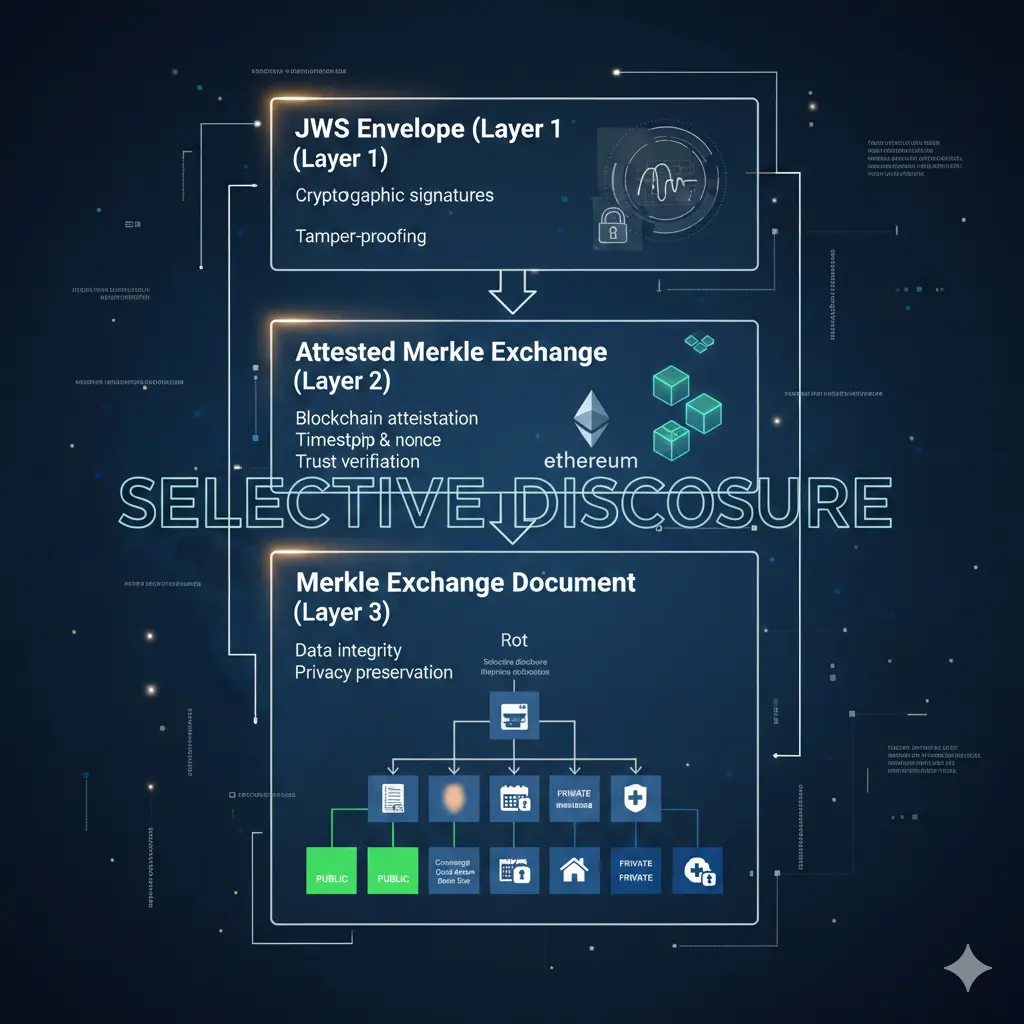
The Three-Layer Architecture
ProofPack uses a layered security approach that makes tokenization possible:
┌─────────────────────────────────────┐
│   JWS Envelope (Layer 1)            │
│   - Cryptographic signatures        │
│   - Tamper-proofing                 │
└─────────────────────────────────────┘
           │
           ▼
┌─────────────────────────────────────┐
│ Attested Merkle Exchange (Layer 2)  │
│   - Blockchain attestation          │
│   - Timestamp & nonce               │
│   - Trust verification              │
└─────────────────────────────────────┘
           │
           ▼
┌─────────────────────────────────────┐
│ Merkle Exchange Document (Layer 3)  │
│   - Selective disclosure           │
│   - Data integrity                 │
│   - Privacy preservation           │
└─────────────────────────────────────┘
Layer 1: JWS Envelope (Cryptographic Signatures)
The outermost layer provides cryptographic signatures:
{
  "payload": "eyJtZXJrbGVUcmVlIjp7ImhlYWRlciI6eyJ0eXAiOiJhcHBsaWNhdGlvbi9tZXJrbGUtZXhjaGFuZ2UtMy4wK2pzb24ifSwibGVhdmVzIjpb...",
  "signatures": [
    {
      "signature": "bd55fef2ed35fbac338f19a412c65f2fc59456d01f00da2e51f4488528634f6363dbac63cb52a80e4105847208130d81c0f00853c9019596de12e89bea1f77fd",
      "protected": "eyJhbGciOiJFUzI1NksiLCJ0eXAiOiJKV1QiLCJjdHkiOiJhcHBsaWNhdGlvbi9hdHRlc3RlZC1tZXJrbGUtZXhjaGFuZ2UranNvbiJ9"
    }
  ]
}Purpose: Ensures the document hasn't been tampered with and proves who created it.
Layer 2: Attested Merkle Exchange Document (Blockchain Attestation)
The middle layer adds blockchain attestation:
{
  "merkleTree": { /* Layer 3 structure */ },
  "attestation": {
    "eas": {
      "network": "base-sepolia",
      "attestationUid": "0x27e082fcad517db4b28039a1f89d76381905f6f8605be7537008deb002f585ef",
      "from": "0x1234567890123456789012345678901234567890",
      "to": "0x0987654321098765432109876543210987654321",
      "schema": {
        "schemaUid": "0x0000000000000000000000000000000000000000000000000000000000000000",
        "name": "PrivateData"
      }
    }
  },
  "timestamp": "2025-01-15T12:00:00Z",
  "nonce": "7fdfcd85d476bc28bb5356d15aff2bbc"
}Purpose: Links the data to an immutable blockchain record, creating verifiable trust.
Layer 3: Merkle Exchange Document (Selective Disclosure)
The innermost layer contains the actual data with selective disclosure:
Complete Tree (All Leaves Revealed):
{
  "header": { "typ": "application/merkle-exchange-3.0+json" },
  "leaves": [
    { "data": "...", "salt": "...", "hash": "...", "contentType": "..." },
    { "data": "...", "salt": "...", "hash": "...", "contentType": "..." },
    { "data": "...", "salt": "...", "hash": "...", "contentType": "..." }
  ],
  "root": "0x1316fc0f3d76988cb4f660bdf97fff70df7bf90a5ff342ffc3baa09ed3c280e5"
}
Selectively Disclosed Tree (Some Leaves Hidden):
{
  "header": { "typ": "application/merkle-exchange-3.0+json" },
  "leaves": [
    { "data": "...", "salt": "...", "hash": "...", "contentType": "..." },
    { "hash": "0xf4d2c8036badd107e396d4f05c7c6fc174957e4d2107cc3f4aa805f92deeeb63" },
    { "data": "...", "salt": "...", "hash": "...", "contentType": "..." }
  ],
  "root": "0x1316fc0f3d76988cb4f660bdf97fff70df7bf90a5ff342ffc3baa09ed3c280e5"
}Notice: The root hash is identical in both versions. This is the key to selective disclosure.
How Selective Disclosure Works
-
Original Tree: All leaves contain
data,salt, andhash -
Redaction: To hide a leaf, remove its
dataandsaltfields, keeping only thehash -
Verification: Verifiers can still:
-
Recompute the root hash using all leaf hashes (including hidden ones)
-
Verify the root hash matches the one attested on-chain
-
Trust that the creator knows the hidden data (because they have the correct hash)
-
Why This Enables Tokenization
The Root Hash is the Token
The root hash (0x1316fc0f...) acts as a unique identifier for the asset. It:
-
Proves existence: The hash exists on-chain, proving the asset was created
-
Proves authenticity: Can't be faked without knowing all the original data
-
Enables trading: Can be transferred, verified, and trusted without revealing details
-
Maintains privacy: Hidden information stays hidden until revealed
Progressive Disclosure
As trust and commitment increase through the transaction lifecycle:
-
Initial listing: Minimal information revealed (enough to evaluate)
-
Bidding/negotiation: More information revealed as needed
-
Final transaction: Full information revealed to the winning party
All using the same root hash, proving it's the same asset throughout.
Summary: Why ProofPack is Ideal for Tokenization
ProofPack enables tokenization of real-world assets through:
-
Cryptographic Proof of Existence: The root hash proves the asset exists and is authentic
-
Selective Disclosure: Reveal only what's needed at each stage of the transaction
-
Progressive Trust: Same proof can be progressively revealed as commitment increases
-
Privacy Preservation: Sensitive information stays hidden until the right moment
-
Verifiable Authenticity: All parties can verify the data is real without seeing everything
-
Blockchain Integration: Immutable on-chain attestation creates trust
-
Self-Sovereign: Users control their proofs and can create selective disclosures themselves
The Key Insight: The root hash acts as a unique, verifiable token for the asset. It remains constant regardless of which leaves are revealed or hidden, enabling cryptographic verification while maintaining privacy throughout the transaction lifecycle.
This makes ProofPack ideal for tokenizing:
-
Insurance quotes and policies
-
Invoices and trade documents
-
Real estate records
-
Supply chain certificates
-
Identity credentials
-
Financial statements
-
Medical records
-
And any other real-world asset that needs verifiable proof with privacy controls
That's lovely and everything but what is Zipwire?
Zipwire Collect handles document collection for KYC, KYB, AML, RTW and RTR compliance. Used by recruiters, agencies, landlords, accountants, solicitors and anyone needing to gather and verify ID documents.
Zipwire Approve manages contractor timesheets and payments for recruiters, agencies and people ops. Features WhatsApp time tracking, approval workflows and reporting to cut paperwork, not corners.
Zipwire Attest provides self-service identity verification with blockchain attestations for proof of personhood, proof of age, and selective disclosure of passport details and AML results.
For contractors & temps, Zipwire Approve handles time journalling via WhatsApp, and techies can even use the command line. It pings your boss for approval, reducing friction and speeding up payday. Imagine just speaking what you worked on into your phone or car, and a few days later, money arrives. We've done the first part and now we're working on instant pay.
All three solutions aim to streamline workflows and ensure compliance, making work life easier for all parties involved. It's free for small teams, and you pay only for what you use.